


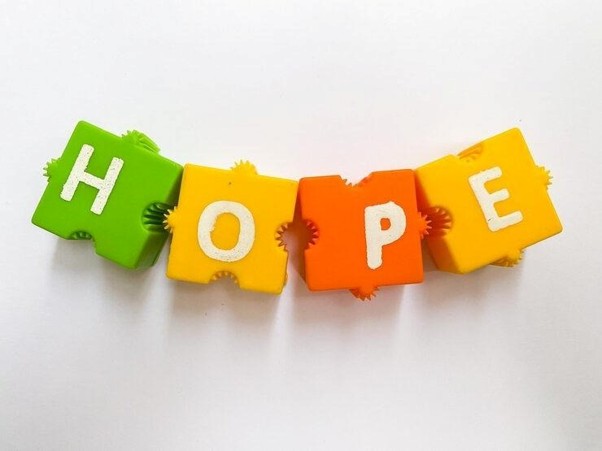
Have you ever had hope for something? Maybe from small ones, such as hoping to do well on a test, to big ones, or thinking that you will be fine no matter how hard the circumstances are, people all have their own hopes. If you have ever had it, it would have made you feel good. Can hope help change the results though? While a lot of people may not think so, science says that it can, with this psychological method: hope therapy. Hope therapy not only changes your thinking, but also how you live your life, by making you achieve your goal despite difficulties, eventually making you a happier, healthier person.
Hope therapy is a psychological method that enables you to set your goals, find pathways, and take actions, which makes you a happier person eventually. First, you set a list of things that you would like to accomplish. It may include the grade that you would want to get or building a habit that could benefit you (The Pennsylvania State University). Then, you search for pathways to achieve the goals. The important thing to remember at this stage is that you still should not ignore the possibility that your plan might not work out. That is why you need to generate alternative ways while holding on to hope at the same time to cope with future difficulties (Deng et al. 2). In the long term, these habits can increase overall happiness and hope in your life as you experience success and satisfaction when you reach your planned goals. (The Pennsylvania State University)
Hope therapy not only makes you happier, but it improves your health. According to research, cancer patients who received hope therapy saw a significant decrease in both physical and mental symptoms of cancer (Chan et al. 1).
Thanks to the positive effects of hope therapy, the patients begin to gain hope which leads them to become healthier and recover from their disease. The more hope that we have, the more frequent “healthier behaviors, regardless of their clinical status” are shown and the more pain, fatigue, and symptom burden decrease (Duggleby 518–519).
Furthermore, hope therapy can make our body’s system function better by giving us hope. Hope therapy decreases stress resulting in the prevention of cortisol elevation (The Pennsylvania State University; Duggleby 517; Harvard Medical School). Then, digestive problems, heart disease, heart attack, high blood pressure and stroke, sleep problems, weight gain, and problems with memory and focus can be prevented. A lot of you may think that while hope makes you feel good, it may not give you visible impacts. However, studies show that it can help you lead your life, achieve goals, and gain happiness and health.
By. Hangyul Park
Works Cited
Chan, Kitty, et al. “A Brief Hope Intervention to Increase Hope Level and Improve Well-Being in Rehabilitating Cancer Patients: A Feasibility Test.” Sage Open Nursing, vol. 5, 2019,
pp. 1-13. Sage Journals, https://journals.sagepub.com/doi/10.1177/2377960819844381.
Deng, Zuobing, et al. “Hope therapy brings hope: an empirical study of a curriculum intervention to enhance school adaptation of Chinese high school freshmen.” Frontiers in Psychology, vol. 16, 2025, pp. 1-12. Frontiers in Psychology, https://www.frontiersin.org/journals/psychology/articles/10.3389/fpsyg.2025.155536 4/full.
Duggleby, Wendy. “Hope and Adult Chronic Illness.” The Oxford Compendium of Hope, Oxford University Press, 2025, pp. 515–528. Oxford Academic, https://academic.oup.com/book/61728/chapter/541576805.
Harvard Medical School. “Understanding the stress response.” Harvard Health, 3 April 2024, https://www.health.harvard.edu/healthy-aging-and-longevity/understanding-the-st ress-response. Accessed 24 April 2026.
The Pennsylvania State University. “Hope Therapy.” Applied Social Psychology (ASP) – The Pennsylvania State University, 6 2 2024,
https://sites.psu.edu/aspsy/2024/02/06/hope-therapy/. Accessed 22 April 2026.