


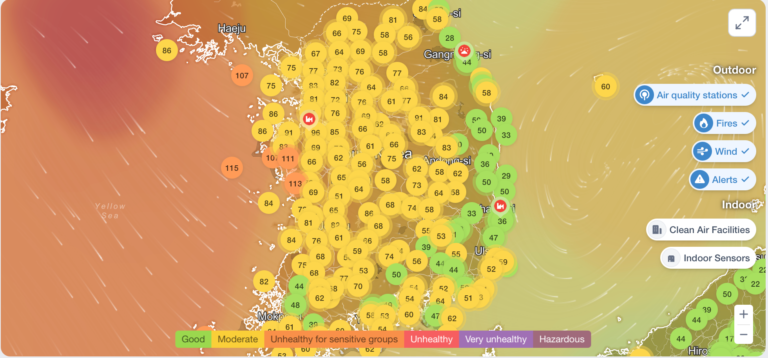
These days, air pollution is a serious issue worldwide, especially in Seoul, South Korea. According to WHO, Air pollution is contamination of the indoor or outdoor environment by any chemical, physical, or biological agent that modifies the natural characteristics of the atmosphere. The major causes for air pollution are natural causes or causes generated by humans. In Seoul, air pollution is a serious and chronic problem. Air quality is worst during winter and early spring. The government is trying to improve air quality, but PM 2.5 has already exceeded the WHO guidelines. This essay will explain the main air pollutants in Seoul, the sources, and when they are most prevalent, as well as the solutions.
First of all, the first two major pollutants in Seoul are PM 2.5 and PM 10. They are particulate matters. According to the EPA, PM stands for particulate matter and they are mixtures of solid particles and liquid droplets found in the air. PM 2.5 is the fine inhalable particles, with diameters of generally 2.5 micrometers or smaller, whereas PM 10 is the inhalable particles with diameters of generally 10 micrometers or smaller. PM 2.5 and PM 10 are most prevalent in spring and winter because of yellow dust storms in spring and temperature inversion in winter. Main sources are being emitted directly from a source such as construction sites or unpaved roads, industrial emissions, or pollutants from neighboring counties. The effects on humans are that they can worsen lung functions, headaches, and long-term risks of cardiovascular functions. Moreover, ground-level ozone (O3) is another pollutant that is affecting air pollution. According to the EPA, ozone is a gas composed of three atoms of oxygen and occurs both in the Earth’s upper atmosphere and at ground level. Ground level ozone is formed when sunlight reacts with NOx and VOCs. It is most prevalent in summer daytime when sunlight is strong. Main sources are car exhaust for NOx and industrial emissions for VOCs. Ground level ozone negatively affects humans as humans can have problems such as coughing, shortness of breath, and the negative impact on lung functions.
The air pollutants are currently harmful and have a negative impact on humans and nature, so strategic solutions for the future would be important. Main solutions can be expanding public transportation in order to reduce the use of vehicles, reducing the use of coal power plants , and increasing renewable energy use. Overall, reducing air pollution in Seoul requires both government policy changes and individual actions to better protect the environment.
By. Jeonghwa Oh
Works Cited
https://www.iqair.com/south-korea
https://www.epa.gov/ground-level-ozone-pollution/ground-level-ozone-basics
https://www.epa.gov/pm-pollution/particulate-matter-pm-basics