


In the movie Interstellar, an imaginary planet called Planet Miller is introduced in the storyline. Cooper, the protagonist and the pilot for the fictional space mission featured in the movie, constantly urges his teammates to work faster on the planet since one hour on that planet is equal to 7 years on earth. Not even a second was to be wasted on the planet if he wanted to make it back to Earth on time to see his family again. While the whole concept of time dilation in this scene sounds like someone made it up, it can actually be explained by a theory developed by our favorite crazy-haired scientist, Albert Einstein.
You’ve probably heard about the phrase “Time is relative”. It refers to Einstein’s Theory of relativity. His predecessor, Newton, thought time and space are constant no matter what. Einstein contradicted this idea, suggesting that the laws of physics and speed of light are the ones that are unchanging. He showed that time and space are relative, while the laws of physics and speed of light are unchanging regardless of the observer.
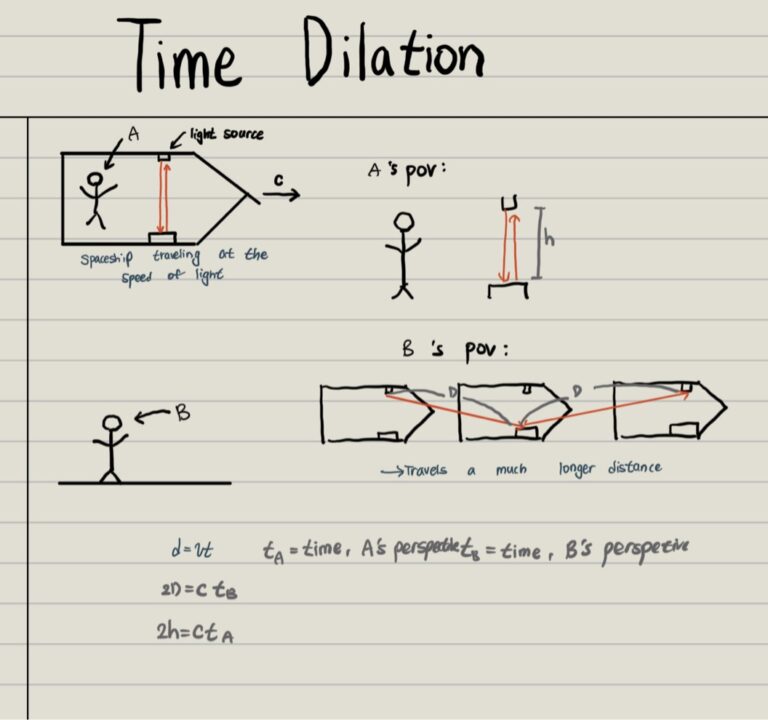
Imagine this: An astronaut measures the time it takes for a beam of light to shoot down at a mirror in the direction perpendicular of the movement of the spacecraft he is in, which is moving at the speed of light. (Refer to diagram) The astronaut sees the light shoot directly down and back up, while an earthbound observer would see the light travel a much longer distance. According to Einstein’s theory of special relativity mentioned above, the speed of light is constant. Since the distance the light traveled perceived by the Earthbound observer is longer while the speed of it is constant, the time is relatively longer. Something to note about this situation is that the same thing happens in the opposite direction. When the astronaut observes earth from the spacecraft, the astronaut will also perceive time on earth as going slower than someone who is actually standing on earth perceives it.
The muon is a type of fundamental subatomic particle, which often hits the Earth because of the collision of cosmic particles. It is very unstable and has a very short half-life (time it takes for the quantity of a substance to be reduced to half of its initial value) of about 1.52us(microseconds), which doesn’t give the particles enough time to reach the surface of the earth. Despite these constraints, muons can be observed on the surface of the Earth quite often. This phenomenon can also be explained by time dilation. Some of the Muons that head towards the Earth move at the speed of light. In our frame, the Muon’s lifespan dilates, giving the Muon enough time to reach the surface of the earth before it decays completely.
Back to Interstellar. While the previous examples were explained by Einstein’s theory of special relativity, Interstellar shows time dilation that can be explained by his theory of general relativity, where time is not only affected by acceleration, but gravitational pull as well. In the movie, Miller’s planet is depicted as existing in a warped space and time because it exists inside a large black hole’s gravitational pull. The light waves lose energy because of the gravitational pull, making the frequency of the light lower. From an Earthbound perspective, it takes longer for the light waves to vibrate the same amount as the source of the light, which is miller’s planet. This is why time on Miller’s planet is perceived to be much slower than time on earth. The difference between this and the examples mentioned earlier is that the slowed down perception is one-way. Observers on Earth, such as Cooper’s children, will perceive Cooper’s time as going slower, while Cooper, who is on Miller’s planet, will perceive Earth’s time as going faster. Once he manages to return to Earth, he will be noticeably not aged compared to the Earthbound observers. It’s crazy how time’s “commitment issues”, backed by equations and experiments, can explain everything from tiny particles at Earth’s surface to scenes in Interstellar.
By. Seojin Yun
Works Cited
https://www.livescience.com/what-is-time-dilation
https://www.iop.org/explore-physics/big-ideas-physics/relativity