


Alzheimer’s disease is a neurodegenerative disease. Neurodegenerative disease is a condition where nerve cells in the brain of the nervous system gradually lose function and die. These diseases get worse over time and affect memory, movement, speech or behavior. Factors that are known to cause this disease are aging, genetics and environment. There are mainly 2 types of this disease, Dementia-type disease and Parkinsonism-type diseases. In this article, I will be focusing on dementia-type diseases since I want to research Alzheimer’s disease. Dementia-type diseases cause progressive damage to various areas of your brain, causing neurons in several areas of your brain to die. That can cause a wide range of symptoms depending on brain areas affected. Alzheimer is one of them.
Scientists do not fully know the exact single cause of Alzheimer’s disease. But at a basic level, many scientists believe that it is caused by protein that doesn’t function as usual. Amyloid plaques, which is a protein, clump together and interfere with cell work. Beta-amyloid is a fragment of a larger protein. When these fragments clump together, they affect communication between brain cells. The clumps form larger deposits called amyloid plaques. Tau proteins play a part in a brain cell’s internal support and transport system to carry nutrients and other essential materials. In Alzheimer’s disease, tau proteins change shape and organize into structures called neurofibrillary tangles. The tangles disrupt the transport system and cause damage to cells.
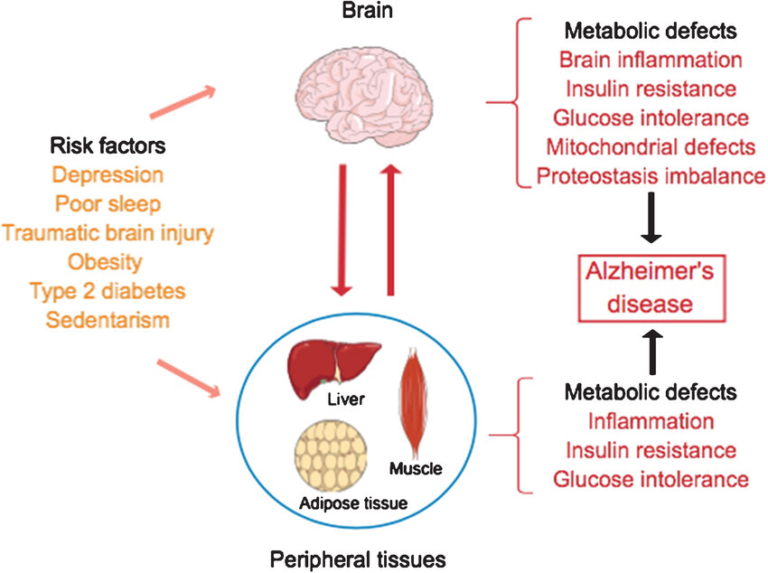
In this article, I want to know if we can perceive Alzheimer’s disease as a metabolic disease. Metabolic disease occurs when abnormal chemical reactions in the body disrupt the normal process of breaking down food and converting it into energy. AD(Alzheimer’s disease) could be highly associated with metabolic disease defined as a combination of hypertension, hyperlipidemia, obesity and type 2 diabetes mellitus ( T2DM ). Among these, the connection between AD and T2DM has been deeply studied. Having T2DM may increase the risk of having AD. T2DM makes you get resistance to Insulin-degrading enzymes(IDE) which breaks down amyloid-b . Cells stop responding to IDE, leaving glucose trapped in the bloodstream instead of fueling the body. The brain also relies on insulin signaling for energy and memory; resistance starves neurons of proper fuel. Insulin resistance interferes with the brain’s ability to clear toxic amyloid-beta proteins and tau, accelerating plaque formation and this process increases the chance of the brain getting Alzheimer’s. Hypertension is also one of the metabolic diseases. Chronic high blood pressure exacerbates neurodegenerative processes by accelerating cerebrovascular dysfunction, impairing the clearance of amyloid-b, promoting tau pathology and causing microvascular damage. These factors generated by hypertension increase the probability of having AD. Hyperlipidemia also increases the risk of getting AD. Having Hyperlipidemia means you have too much cholesterol. Cholesterol( low density lipoprotein) leads to a build up of cholesterol in your arteries. This can cause more proteins to build up in the brain. Which means it will increase the possibility of having AD.
Type 2 diabetes mellitus, hypertension, and hyperlipidemia, which are metabolic diseases, are known to increase the risk of having Alzheimer’s by insulin that disturbs the body’s function of breaking down amyloid-b and tau protein. Environmental AD risk factors rarely exist alone. T2DM, hypertension and hyperlipidemia often coexist. AD is a disease without any effective treatment. Since no current drug intervention can modify AD, in order to find effective treatment, scientists should focus on insulin signaling.
By. Madison Yi
Works Cited
https://pubmed.ncbi.nlm.nih.gov/24249045/
https://benbikman.com/alzheimers-metabolic-disorder/
https://extendingme.com/alzheimers-disease-is-not-just-a-brain-disorder-its-a-metabolic-one/
https://www.sciencedirect.com/science/article/pii/S3050623924000063