


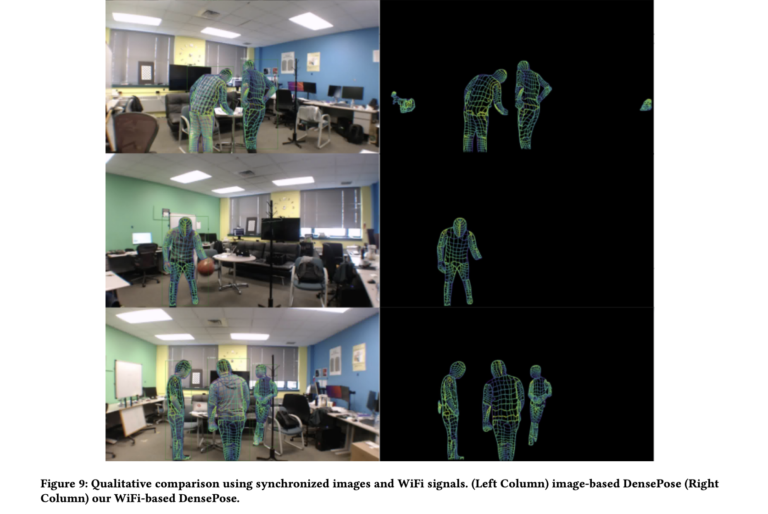
In the 21st century, your Wi-Fi can see you, this seemingly absurd statement is surprisingly true. When you think about Wi-Fi, you probably think about connecting your phone to the internet to watch videos, play online games, etc.. However, recent studies have shown that Wi-Fi can do something much more surprising: it can detect human movement.
Researchers have developed a technology called Wi-Fi sensing that can analyze changes in wireless signals to determine whether not only a person is moving, but also their vitals such as their heart rate and respiration. Unlike a security camera, it does not need to capture an image of the person physically. Instead, it uses the way a person’s body affects invisible radio signals constantly traveling through a room.
Your Wi-Fi signal is never really “straight”
A Wi-Fi signal does not simply travel from a router directly to your phone. Inside a room, radio waves reflect and scatter off walls, furniture, floors, ceilings, and other objects constantly. This creates multiple paths for the signal to reach a receiver, and this process is otherwise known as multipath propagation.
Now, if you put a person into that environment, a human body absorbs, reflects, and scatters some of that radio energy, thus disturbing the signal. When that person walks across the room or moves an arm, the paths taken by the signal change. Thus the receiver sees a slightly different version of the wireless channel along its path.
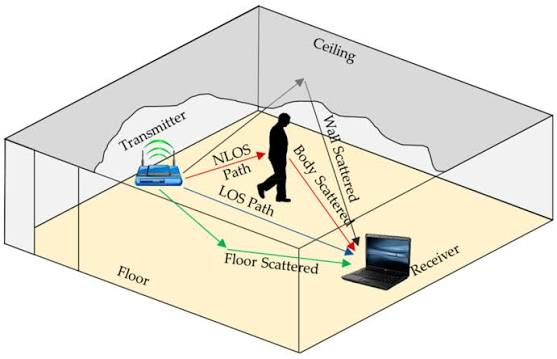
(https://www.researchgate.net/figure/Wi-Fi-signal-propagation-in-an-indoor-environment_fig2_334231546)
That change is imperative to Wi-Fi sensing, the system does not need to produce an image of the person. Instead, it measures how the wireless environment changes around a moving object and uses those changes to infer what is happening.
The Secret is CSI(Channel State Information)
The key technology behind Wi-Fi sensing lies in Channel State Information (CSI). CSI describes how a wireless signal changes as it travels between a transmitter and receiver. Furthermore, modern Wi-Fi divides a wireless channel into smaller frequency components called subcarriers, allowing devices to measure changes in the signal’s amplitude and specific phase.
So, when a person moves through a room, their body changes the paths that radio waves take, thus creating measurable changes in the CSI data. Instead of receiving a tangible photo or image, the computer receives a stream of numbers describing how the wireless channel is changing. Then it can utilize signal-processing techniques to clean up the data and identify useful patterns.

(https://tns.thss.tsinghua.edu.cn/wst/docs/pre/)
Teaching Wi-Fi to recognize movement
This is where machine learning becomes important: researchers would collect CSI data as people go about their daily movements. A machine-learning model can study these examples and learn which patterns in the wireless signal correspond to different activities. Moreover, more advanced systems can perform human pose estimation, in which algorithms estimate the positions of different parts of a person’s body using only changes in the wireless signal. Instead of seeing the movement and recording the signal, it observes the signal and tries to determine what movement caused it.
One outstanding example of using machine learning to somewhat accurately predict not only the positions of people but also their vitals is Ruview: https://cognitum.one/ruview. Ruview is an open-source Wi-Fi sensing project that collects CSI information for AI to decode using Wi-Fi hardware such as ESP32-based devices, specifically models like the ESP32-S3 or ESP32-C5, which acts as the low-cost edge sensing hardware node that captures raw radio frequency data from standard Wi-Fi signals. and process the measurements to detect human presence and movement.
Moreover, the project is capable of breathing detection, fall detection, and human-pose estimation. One of its additional features is the representation of a person as a 17-keypoint skeleton, estimating points corresponding to different parts of the body from changes in Wi-Fi signals. Although RuView is only experimental, it opens up broad possibilities for people to modify and utilize it to get hands-on experience with body motion detection using Wi-Fi sensing technology. Furthermore, its performance depends on factors such as the hardware, room layout, signal conditions, calibration, and number of people. (https://github.com/ruvnet/RuView?utm_source)
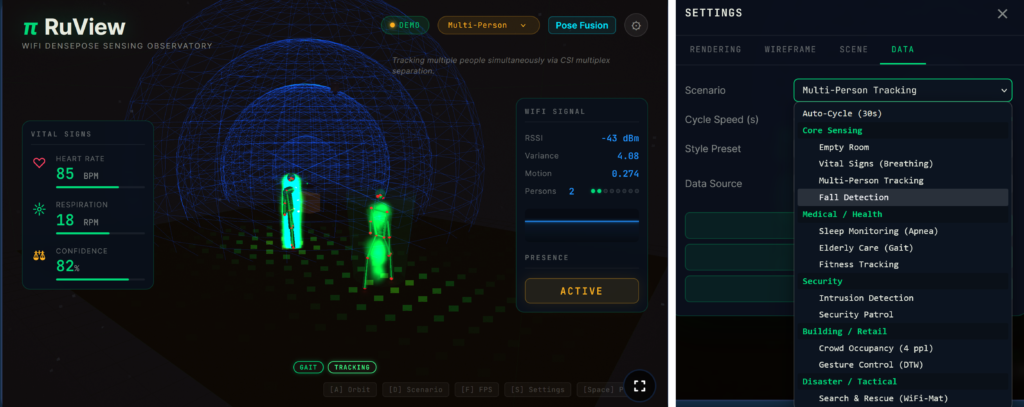
(Screenshot taken by Tyler An in demo of RuView)
Why does this matter?
Wi-Fi sensing could have useful applications in smart homes, healthcare, security, and accessibility, or could be purely explored as a passion project. A system could detect when someone enters a room, recognize certain movements, or potentially detect a fall without requiring the person to wear a device for elders in healthcare settings. It could also be useful in places where cameras are undesirable because the system works from radio measurements rather than conventional video.
But the technology also creates serious privacy concerns, as a Wi-Fi system could potentially learn when someone enters a room or recognize patterns in their movement without recording a traditional video. Even without seeing someone’s face, information about their movements could reveal details about their daily routines for malicious purposes such as spying on someone without their consent or acknowledgement. As recently, there are videos on YouTube that explore the capabilities of RuView by adapting it into a mobile device that is meant to detect human motions, and this can easily be recreated and used in harmful ways if one puts its mind to it.
The core element behind it is quite simple: movement changes the wireless signal, CSI records those changes, and AI attempts to interpret them using algorithms through machine learning. What started as technology designed to send internet data is now being studied as a way to sense the physical world, therefore, the future of motion tracking technology using Wi-Fi signals is broad. Projects such as RuView show how this idea can move from research into real experiments, although the technology still has significant limitations. Wi-Fi may not have eyes, but with the right hardware, mathematics, and AI, it can learn to sense what is happening around it.
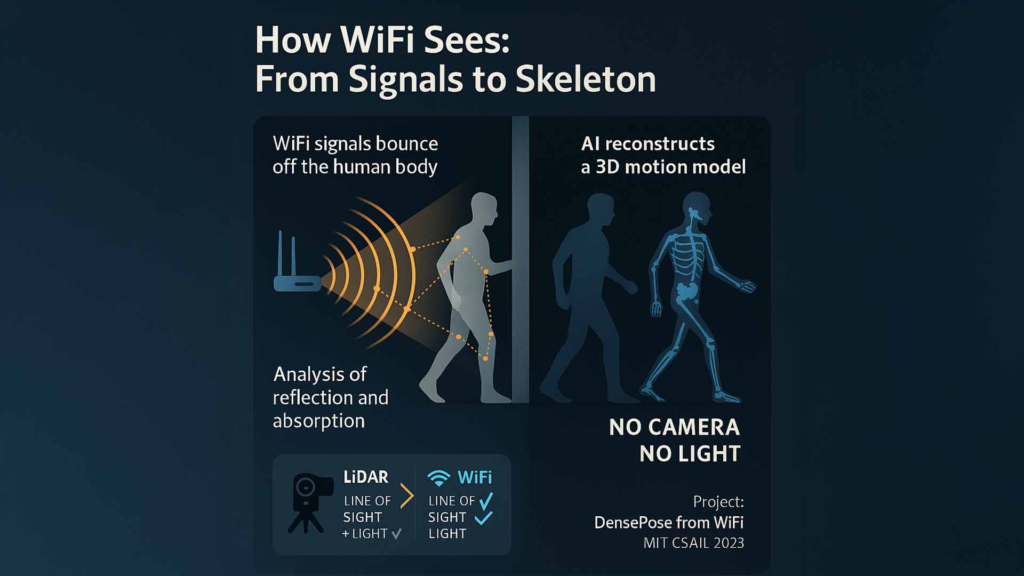
(https://www.xrstager.com/en/ai-based-motion-detection-without-cameras-using-wifi)
by Tyler An
Works Cited
Liu, Jiao, et al. “Human Activity Sensing with Wireless Signals: A Survey.” Sensors, vol. 20, no.4, 2020, article 1210, doi:10.3390/s20041210.
Zou, H., et al. “A Survey on Human Behavior Recognition Using Channel State Information.” IEEE Communications Surveys & Tutorials, 2019.
“RuView.” GitHub, ruvnet, 2026, github.com/ruvnet/RuView.