


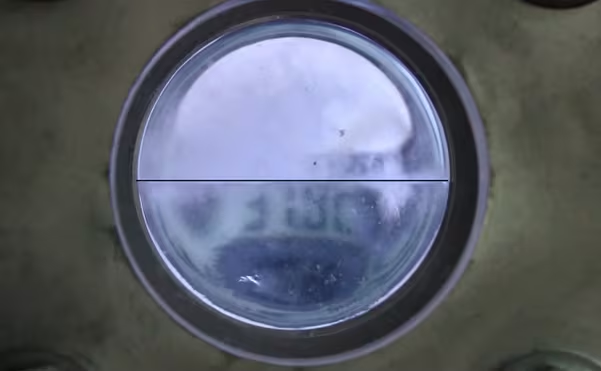
When high heat is applied to a liquid, it becomes gas. When high pressure is applied to gas, it becomes liquid. But what happens when both extremely high pressures and temperatures are applied to a substance? It becomes a strange, in-between substance called a supercritical fluid.
A supercritical fluid can be defined as a substance found at extreme temperatures and pressures beyond a point called the critical point which is known as the specific temperature and pressure that determines the phase boundary between liquid and gas. Like such, each substance has a unique critical point where distinct liquid and gas phases disappear.
However, Supercritical fluids are different as they have both the properties of a gas and liquid at the same time. For example, the viscosity of a supercritical fluid is similar to that of a gas, which means they can move through substances like a liquid.
What is more interesting is that they have the density of a liquid, allowing them to dissolve substances like a solid. Supercritical fluids also have no surface tension because the molecules do not attract with each other. Without surface tension, there is no capillary resistance, which means they can reach tiny spaces that liquids can’t get to. Also, it doesn’t have a meniscus. A meniscus is the curve formed on a surface of a liquid because of its surface tension. When the substance transforms into a supercritical fluid, the meniscus flickers and then vanishes entirely.
Because of these unique properties, supercritical fluids have many usages. For instance, the low viscosity of supercritical CO₂ is used to extract caffeine from coffee beans. It permeates the bean’s cellular structure. The CO₂ selectively extracts the caffeine from the beans, then the pressure is lowered to precipitate caffeine from the CO₂. They can also be used to process certain materials such as aerogel. Aerogel is often considered the “lightest solid on earth”. To make the substance, drying of the liquid solvent in a gel is required. Unlike traditional drying methods, supercritical fluids offer a technique where the aerogel does not lose its porous properties and shrinkage of the aerogel is prevented.
By. Seojin Yun
Works Cited
https://www.scimed.co.uk/education/what-is-a-supercritical-fluid/
https://link.springer.com/chapter/10.1007/978-94-011-2146-0_1
https://www.sciencedirect.com/science/article/abs/pii/S0896844612000757