


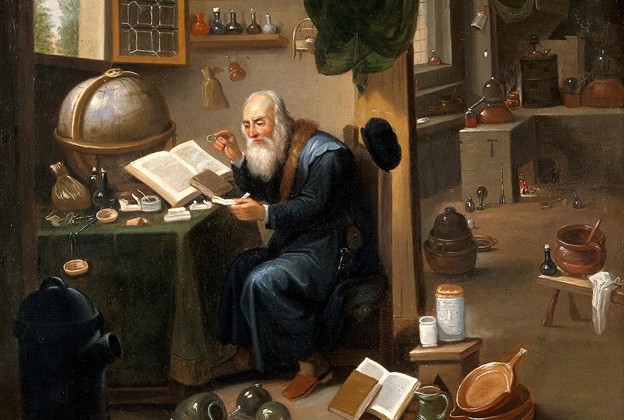
Alchemy has contributed to modern chemistry and has fascinated people for centuries. It represents one of humans earliest attempts to understand the nature of matter. Alchemists believed that they could transform ordinary metals into gold. Even though this goal was never achieved, it still played a crucial role in modern chemistry.
Alchemy was a mixture of early science, philosophy and superstition that was developed in regions such as Egypt, Europe, China and India. The goal of the alchemist was to achieve chrysopoeia( transmuting metals into gold) and find the philosopher’s stone, a mythical substance that could grant eternal life. They believed that metals had a ranking and it was an immature form of higher metal such as gold. They studied alchemist not only because they were greedy but also because they believed gold was resplendent with spiritual beauty and had triumphed over the lurking power of evil. They also developed a basic set of laboratory techniques, theories and terms which some of them are still used today.
The main reason why Alchemy failed is because of both lack of proper understanding of history and science. When an alchemist found out something, they kept it only with themselves and didn’t share it with others, so next generations were unable to step further from it. Sharing experiences and knowledge with each other and sharing each other’s perspective are important in every field, especially in science. By sharing each other’s opinion, it made scientists try new things and discover a new path. But alchemists kept their knowledge secret by creating their own letters and symbols so that no one could read it. This delayed the further development of alchemy.
One reason we know for sure why alchemy failed is that it is physically impossible. Gold is made from a very high pressure (stellar core level of pressure and temperature) because it has 79 protons. To turn normal metal into gold, you need to change the number of protons which need to cause nuclear transmutation. It is theoretically possible, but not physically possible today.
Unable to understand science fully was a major reason that alchemy failed, in fact, alchemy was much more like philosophy. Alchemists view material worlds like turning metal to gold as a metaphor for spiritual purification and enlightenment, seeking perfection in both matter and self. It was deeply tied to natural philosophy, hermeticism[ a mystical tradition based on writing ] and other mystical traditions.
Alchemy failed because it was built on incorrect theories, limits of systematic methods and lacked understanding of science fully. It was more of a philosophical subject that science was used to. But various attempts to convert metals into gold eventually led to the development of modern chemistry and also reminded us about how essential the sharing of knowledge has contributed to the development of science. The story of alchemy can now guide and remind us a proper way of researching and exploring a new topic and even unsuccessful ideas can deepen the understanding of science.
By. Madison Yi
Works Cited
“Alchemy.” wikipedia, the free encyclopedia, 2025 dec 3, https://en.wikipedia.org/wiki/Alchemy accessed 10 dec 2025
Andrew. “What killed alchemy?” SMCISS , 2018 may 8, https://statmodeling.stat.columbia.edu/2018/05/08/what-killed-alchemy/ accessed 10 dec 2025
“ alchemy.” Philosophyball wiki, 2025 dec 10, https://philosophyball.miraheze.org/wiki/Alchemy accessed 10 dec 2025
Breitbart william. “ Alchemy and psychology” national library of medicine, Pubmed central, 2017 jul 17, https://pmc.ncbi.nlm.nih.gov/articles/PMC5512109/ accessed 10 dec 2025
Blair Ann. “Natural Philosophy.” cambridge core, cambridge university press, 2008 march 28, https://www.cambridge.org/core/books/abs/cambridge-history-of-science/natural-philosophy/F1FD6F16ACFC81FF69E7B62B013C6FF0 accessed 10 dec 2025
“ What is alchemy?” New scientist,https://statmodeling.stat.columbia.edu/2018/05/08/what-killed-alchemy/ accessed 10 dec 2025