


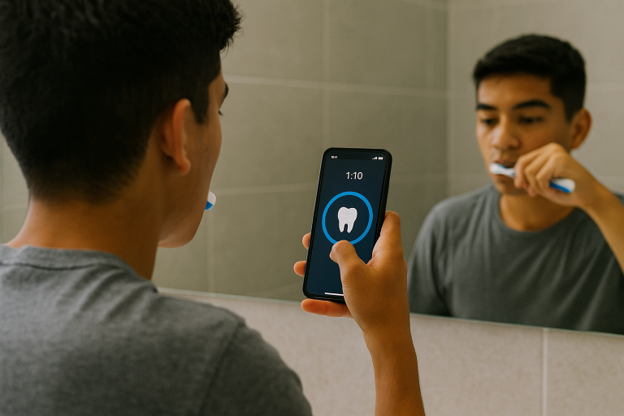
When we think about adolescent health, we usually picture exercise, nutrition, or mental well-being. But there is another area many teenagers overlook: oral health. A recent survey of 100 adolescents in Korea and the United States found that the vast majority of teens (87%) had never even heard of an oral-health app designed to improve brushing habits.
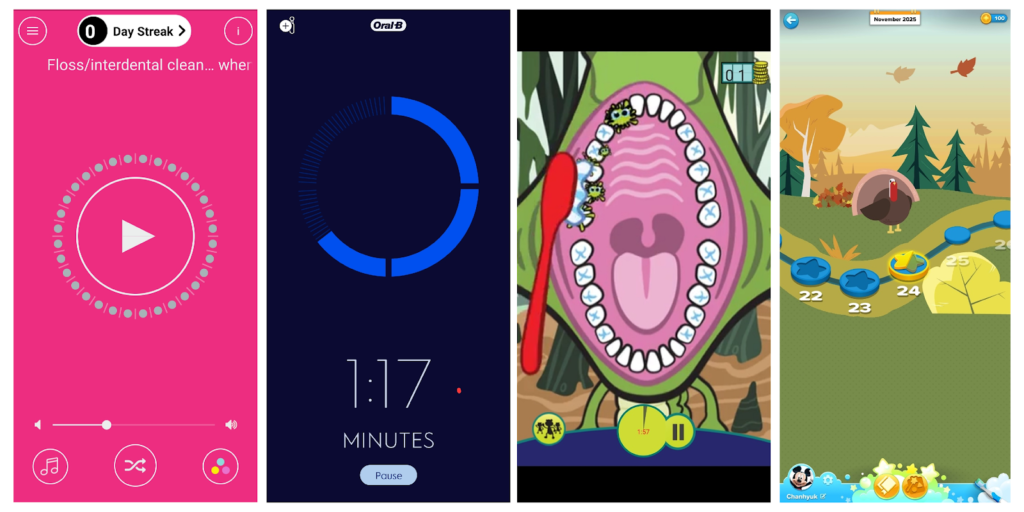
Figure 1. Screenshots of the four oral-health apps used in the study: Brush DJ, Oral-B, Chomper Chums, and Disney Magic Timer.
How Teens Respond to Existing Apps
These four apps were selected because they are free, easy to access, and among the most frequently downloaded oral-health tools available to young users. They represent the major design styles teens are most likely to encounter, from simple timers to character-based missions and smart-brush feedback, and they offer a realistic set for comparing how different features influence teen engagement.
The apps use two-minute timers, music, missions, and visual feedback to help users brush longer and more consistently. Although many children’s apps have been studied in several countries, very few tools are designed with teenagers in mind, even though adolescence is a crucial period for forming lasting health habits.
The survey results showed that only 10 percent replied that they had ever used an oral app and 22 percent said that they brushed for the recommended two minutes, and 40 percent had visited a dentist in the past year. Yet 84 percent of teens said they would try an app if it were built specifically for them.
The data pointed to one clear conclusion. Teens aren’t avoiding these tools but they simply don’t know they exist. And that raised a new question: what would happen if teenagers actually tried them?
To explore this, eight students between the ages of 13 and 17 used four different oral-health apps for two weeks. Some apps played music. Others used characters or smart-brush feedback. Before examining the results, it helps to see how the apps differ.
Comparing the Most Popular Apps
The four apps differ widely in design, tone, and intended users. A short overview helps clarify why teens reacted so differently during testing.
| App Name | Main Features | Strengths | Limitations | Teen Suitability* |
| Brush DJ | 2-minutes timer with music reminders | Free, simple UI; effective for brushing time | Limited educational content | ★★★★☆ |
| Disney Magic Timer | Character rewards sticker collection | Strong gamification engaging for children | Overly childish, ads present | ★★★☆☆ |
| Oral-B Official | Electric toothbrush sync; real-time feedback | Data-driven monitoring, family sharing | Requires a specific toothbrush, limited accessibility | ★★★★☆ |
| Chomper Chums | Animal characters with missions | Intuitive UI; playful design | Too child-oriented, low teen appeal | ★★☆☆☆ |
Hardware dependency (Oral-B) and child-oriented graphics (Disney Magic Timer, Chomper Chums) reduced appeal among older adolescents. Brush DJand Oral-B scored relatively higher in teen suitability, while Chomper Chums was rated lowest despite short-term brushing gains.
Figure 2. Brushing Time Before and After Two Weeks of App Use
All four tools produced noticeable improvements. Brush DJ showed the largest increase, rising from 57.5 seconds to 88.7 seconds. Chomper Chums followed with an increase from 46.2 to 69.6 seconds. Disney Magic Timer rose from 50.4 to 68.5 seconds, and the Oral-B app increased from 42.6 to 62.3 seconds.
These results suggest that simple cues such as music, timers, or real-time guidance help teens stay focused long enough to complete a full brushing routine.
What Teens Liked and Didn’t
The numbers alone were striking, but what teens said about their experience revealed even more. One student laughed and said, “I thought I brushed long enough before, but when I used the timer it turned out my usual brushing was only forty seconds.” Another said, “Two minutes felt much shorter when music was playing. It didn’t feel like a chore anymore.”
Not all parts of the apps resonated with them. “The cartoon characters were cute, but I felt a little embarrassed using them. It didn’t feel like it was made for someone my age,” said Minji, 13. Another student, Jisoo, 16, mentioned the electric-toothbrush requirement. “I liked the feedback, but I misunderstood and thought it required a special toothbrush. It turns out I can use my regular one without any problem.”
These reactions pointed to a clear gap in the current market. Most oral-health apps are designed either for young children or for adults, leaving teenagers somewhere in between. They want tools that are simple and age-appropriate but not childish. When an app matched that balance, they responded immediately. “It motivated me without forcing me. I was brushing longer without really noticing,” said Hyunsoo, 15.
Why Design Choices Matter
The short trial showed that teenagers adapt quickly when apps provide simple cues like timers, music, or quick visual feedback. They keep their phones close and respond naturally to tools that guide them without pressure. But unlike adults, teens also look for light, age-appropriate elements that make the experience feel less like a chore. When an app combines clean design with small motivational features, its use feels natural—and brushing sessions last longer. If developers design with this balance in mind and avoid unnecessary barriers such as hardware requirements, oral-health apps can become a meaningful part of teens’ daily routines.
By. Chanhyuk Lee
Works Cited
Brush DJ. Brush DJ. App Store, https://apps.apple.com/us/app/brush-dj/id528097310 . Accessed 24 Nov. 2025.
“Chomper Chums.” Delta Dental, https://www.deltadental.com/us/en/member-benefits/chomper-chums.html . Accessed 24 Nov. 2025.
Disney Magic Timer. Oral-B, https://oralbappdownload.com/disney-magic-timer . Accessed 24 Nov. 2025.
Oral-B. Oral-B App, https://oralbappdownload.com . Accessed 24 Nov. 2025.
World Health Organization. Oral Health: Key Facts. 2022, https://www.who.int/news-room/fact-sheets/detail/oral-health . Accessed 24 Nov. 2025.
American Dental Association. “Brushing Twice a Day: Recommendations for Teens.” ADA,
https://www.ada.org/resources/research/science-and-research-institute/oral-healthtopics/brushing . Accessed 24 Nov. 2025.