



Tesla has begun carrying paying members of the public in its Cybercab, a two‑seat robotaxi built from the ground up without a steering wheel, brake pedal, or accelerator, marking what the company and many observers describe as the first time a major automaker has put a purpose‑built, control‑free autonomous vehicle into commercial ride‑hailing use. Launched in Austin, Texas, in early September 2026 after an invite‑only event, the Cybercab is not a modified Model Y with hidden controls but a new vehicle architecture designed around Level 4 autonomy, with no steering wheel, pedals, or side mirrors inside the cabin and all interaction handled through a central screen and the Tesla Robotaxi app. Riders hail a Cybercab through the app and are charged fares roughly comparable to standard ride‑hail prices, but service is currently confined to specific zones in Austin with a small initial fleet; only 45 Cybercabs were registered for commercial robotaxi use in Texas at launch, leading to limited coverage and sometimes long wait times as the system scales.
The “actually steering‑wheel‑less” distinction matters because the vehicle’s safety case, interior layout, and user experience all assume no human driver will ever take over within its operational area, unlike supervised systems that still expect a person to intervene, even though Tesla’s broader robotaxi network continues to use Model Y vehicles with manual controls where regulations or technology require a human fallback. Externally, the Cybercab is a compact, gold‑hued two‑seater with upward‑opening “butterfly” doors and space for luggage, optimized for short urban trips rather than long‑distance travel, and Tesla describes it as “natively built for fully autonomous driving,” meaning the hardware and software assume no human driver will ever take over within its operational design domain. Early reports from journalists who took multiple rides describe smooth Full Self‑Driving (FSD) behavior in the geofenced area, but also note limitations: service is confined to specific zones in Austin, fleet size is small, and wait times can be long as the system scales, with some riders experiencing delays or needing to walk to designated pickup points.
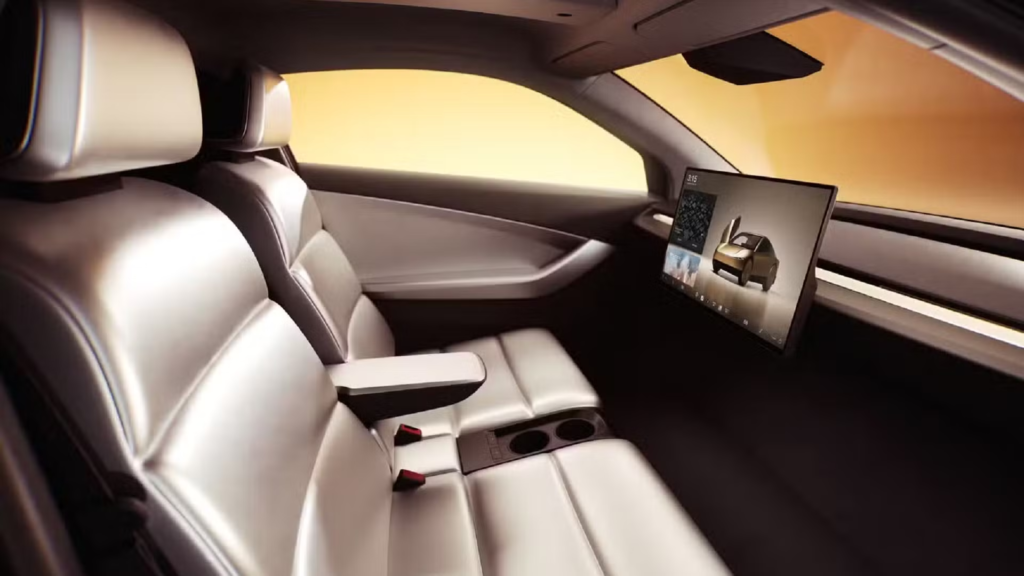
(Photo) The interior of the Tesla Cybercab. It does not have a steering wheel.
The rollout has drawn immediate regulatory attention, with U.S. safety authorities indicating they are evaluating Tesla’s deployment of a steering‑wheel‑free, pedal‑less vehicle on public roads, and Austin’s police and fire departments have reportedly received special training to handle incidents involving these control‑free cars, including extrication in crashes or fires. Tesla has not yet filed for a federal exemption with the National Highway Traffic Safety Administration for mass sale of the Cybercab to consumers, and the vehicle is not currently being sold to individual buyers; the company is instead focusing on corporate and fleet interest, with Elon Musk saying the first customer deliveries could occur before the end of 2026, but the immediate focus remains on expanding the robotaxi service. At the same time, there have been reports that many of the vehicles initially deployed in the fleet actually do have steering wheels installed, undercutting a core promise of the “no controls” design and suggesting that Tesla may be using a mix of configurations as it tests and scales the service.
For now, the Cybercab’s service area remains limited to Austin with no confirmed timeline for expansion to other cities, and Tesla’s next challenges include scaling the fleet, proving reliability under varied weather and traffic conditions, and navigating a patchwork of local and national regulations for fully driverless vehicles. If Tesla can grow the Cybercab network while maintaining safety and acceptable wait times, the “steering‑wheel‑less” claim will shift from a headline to an everyday experience for riders; one that redefines what a taxi interior looks like and who (or what) is actually in control, while also putting pressure on traditional ride‑hail operators and other automakers racing to deploy their own autonomous fleets.
By. Hyeonjun Son
Works Cited
“Tesla Starts Cybercab Rides in Austin, Drawing US Safety Scrutiny.” Reuters, 3 Sept. 2026.
“Tesla Launches Steering‑Wheel‑Free Cybercabs on Austin Streets.” Associated Press (AP News), 3 Sept. 2026.
“Tesla’s Cybercab Launch Catches the Eye of US Auto Safety Regulator.” Business Insider, 4 Sept. 2026.
“Tesla Puts Steering‑Wheel‑Free Cybercab Robotaxi on Austin Roads.” SE Daily, 5 Sept. 2026.
“Tesla Launches Steering‑Wheel‑Free Cybercab Rides in Austin as NHTSA Evaluates Rollout.” TechDogs, 4 Sept. 2026.
“Oops! Many Tesla Cybercabs Actually Do Have Steering Wheels, Undercutting a Core Promise.” Futurism, 12 Sept. 2026. Quoted in “Tesla’s Cybercab Mystery: Why So Many Robotaxis Still Have Steering Wheels,” WebProNews, 12 Sept. 2026.
“Tesla Cybercabs Hit Austin Roads Without Steering Wheels or Pedals.” Mid‑Day, 5 Sept. 2026.
“Tesla Put the Cybercab Into Service in Austin. Europe Is Still Waiting.” Teslant, 4 Sept. 2026.
Crothers, Brooke. “Tesla Cybercab Launches With Closed Event, Riling Some Fans.” Forbes, 3 Sept. 2026.
“Tesla Cybercab First Ride: What It’s Really Like to Use Tesla’s New Autonomous Taxi.” MotorTrend, 8 Sept. 2026.
“Musk Confirms First Cybercab Customer Delivery by End of 2026.” Basenor, 4 Sept. 2026.