



Nowadays, public Wi-Fi networks have become a part of our everyday life, whether you are at a coffee shop, airport, or hotel, you can find yourself and many other people connecting to public Wifi without giving it a second thought. Although public Wifi offers convenience and seemingly innocuous, as it may look like it allows users to save mobile data, the truth is that it can also expose you and others to serious cybersecurity threats. Because these networks are often less secure or just straight up made with malicious intentions, cybercriminals can take advantage of unsuspecting victims who connect themselves with an unknown network by stealing sensitive information.
As more and more people rely on public Wi-Fi, understanding the risks it might carry is pivotal for users in the cybersecurity world.
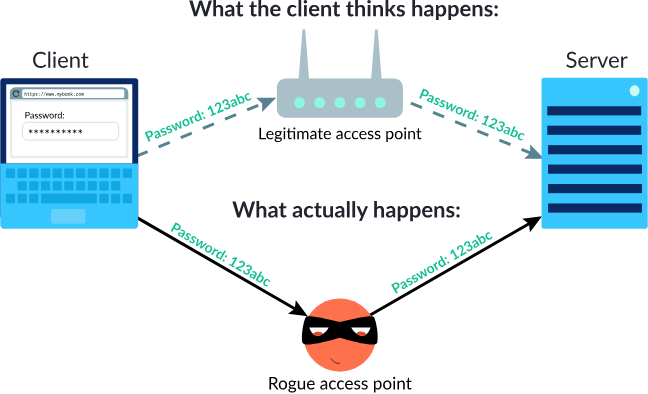
Since the majority assume that connecting to public WiFi is completely harmless, especially when the network appears to be offered by a legitimate business. However, attackers, not only those who have the authorization over the public WiFi, could exploit weaknesses in these networks or create fake WiFi hotspots(Rogue Access Point) to target victims who join the networks. Since people frequently use public WiFi to browse social media, access email accounts, and even conduct financial transactions, the consequences of a successful attack can be grave.
Three major risks associated with using public WiFi networks are:
1. Data Interception
- Data interception is one of the most common dangers of public Wifi, given the fact that many public networks lack proper encryption, attackers are able to monitor information being transmitted between a user’s device and the internet, especially if the site they are visiting is not secure(http instead of https as the traffic would be easier to read since it’s not secure). Additionally, “sniffing” tools that “sniff” out sensitive information from users who are communicating with the internet and devices is done by common applications such as Wireshark, furthermore showing how it is for one to follow through with this attack.
This means that sensitive information, such as login credentials and personal details, could potentially be viewed by attackers. Users often assume that their online activities are private and hidden, well-secure by themselves, but the reality is that their information may be visible to others connected to the same network.
2. Fake Wifi Hotspots (Rogue Access Point – Pineapple Wifi)
- Contrary to some beliefs, cybercriminals can absolutely create fake WiFi networks that appear to be legitimate. For example, an attacker might create a network with a name similar to a nearby coffee shop or airport WiFi service, making it look convincing enough for unsuspecting victims to join the pseudo network.
- When users connect to these fraudulent networks, attackers are able to monitor their internet activity directly, capture login information, or redirect victims to malicious websites. Because these fake network ports are often labeled identically to match legitimate network ports, many users connect without awareness of the risks that might follow as a consequence.
(https://www.khanacademy.org/computing/computers-and-internet/xcae6f4a7ff015e7d:online-data-security/xcae6f4a7ff015e7d:cyber-attacks/a/rogue-access-points-mitm-attacks)
3. Malware Distribution
- Cybercriminals can also use public Wi-Fi networks to distribute malware, causing catastrophic damage. Attackers could exploit vulnerabilities in connected devices or social engineer users into downloading malicious Trojan-type software disguised as a legitimate update or application.
- Once malware is installed, attackers can acquire various sensitive pieces of information about the users, track users’ activities, steal passwords, or even take control of the device by keylogging. In some cases, victims may not realize that their device has been compromised until too much damage is already inflicted upon it. Since malware is distributed in less obvious and discrete ways, users would have a harder time singifiying when they download malicious stuff or even if they are being spied upon.
Despite these risks, millions of people continue to use public Wifi every day without much care due to convenience and comfort. Unfortunately, many users are oblivious and even ignorant of how vulnerable they can become when connecting to an unsecured network. Cybercriminials rely on this lack of awareness to carry out these kinds of attacks successfully, more people must take notice and raise awareness of the topic.
There are several ways to reduce the risks involved with public WiFi, even if they aren’t foolproof, and some compromises have to be made. First, users should avoic accessing sensitive accounts such as online banking services while connected to public networks. Second, it is crucial to verify that the network that they are trying to join is legitimate by confirming its exact name with the business providing it. Last but not least, using a Virtual Private Network (VPN) can drastically help with encrypting the internet traffic and the session between devices and the internet, making it significantly harder for attackers to intercept and read sensitive information.
In conclusion, while public WiFi networks provide comfort and accessibility, they also raise cybersecurity risks that shouldn’t be taken lightly. Date interception, fake WiFi ports, and malware distribution are only some of the various threats users may encounter simply by connecting to a network. Individuals must understand these dangers and take simple yet highly effective precautions so they can better protect their personal information and reduce the likelihood of becoming victims of cybercrime.
By. Geumchang An
Works Cited
Federal Trade Commission. “Using Public Wi-Fi Networks Safely.” Federal Trade Commission,
https://consumer.ftc.gov/articles/using-public-wi-fi-networks-safely. Accessed 13 June
2026.