


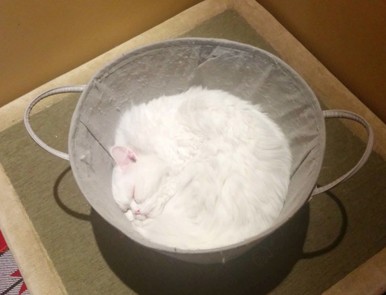
Cats have made life difficult for physicists in many ways over the years. Let’s take a look at a couple of different ways that cats decided to claw at the laws of physics.
The Righting Reflex-Why it Seems Impossible
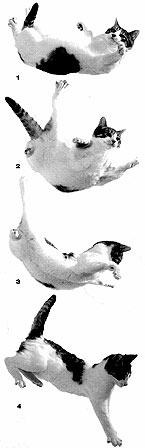
The reason cats always fall on their feet is because of their righting reflex, which helps an animal maintain its upright position when falling, being pushed, or being tilted. Scientists originally thought cats can twist their body to an upright position because they push off the surface that they fall from, until they tried dropping a cat while holding it by its legs and with its back facing down. The cat initially fell straight down, but rotated on its own axis and fell on its feet again. What confounded scientists is the fact that this rotation defies the conservation of angular momentum. It is impossible for an object that is not spinning to suddenly rotate without an external force.
What Actually Happens
The cat’s upper body and lower body rotate in opposite directions, which means the angular momentum is preserved. Since the body rotates in two different directions, each momentum is canceled out, resulting in a net angular momentum of zero.
The cat also draws its front paws closer to its body, reducing the moment of inertia. This action will make the upper body rotate quickly around its own axis. Then it stretches its hind legs to create a large moment of inertia by contrast. While the upper body rotates through a large angle, the legs will rotate in a smaller angle in the opposite direction. By extending its front paws and tightening its hind legs, the cat can perform a pepper mill-like movement to align the hind legs to the front paws. A truly impeccable landing.
Cat Liquid Theory
You’ve probably seen the infamous ‘If it fits, I sits’ meme. But what you probably didn’t know is that the ‘cats are liquid’ theory can actually be scientifically explained.
A liquid is defined as “a substance that has a fixed volume but no fixed shape.” That’s the common definition, but it can also be defined by the Deborah number.
De(Deborah number)= Time of relaxation(λ)/Time of observation (T)
The relaxation time is the time it takes for the material to return to a state of equilibrium. It is extremely long for solids and much shorter for liquids. The time of observation is basically the time span of the experiment. Dropping a cat into a box would mean a short time of observation, while slowly pouring a cat into a box would mean a long time of observation. If De>1, it is generally considered a solid. If De<1, it is generally considered a liquid. Suppose someone tried to grab a cat mid-jump. That would mean a very short T, which means the cat is solid. Then if the cat slowly sunk into a basket over 5 minutes, that would mean a much longer T compared to the time of relaxation. The cat would be considered liquid.
We really need to keep cats away from physics before they make physicists develop another strange theory…
By. Seojin Yun
Works cited
https://www.nature.com/articles/s42254-025-00824-6
https://gwern.net/doc/cat/biology/2014-fardin.pdf
https://www.scientificamerican.com/article/why-do-cats-land-on-their-feet-physics-explains/
https://www.sciencedirect.com/topics/neuroscience/righting-reflex#:~:text=A
Image links
https://www.boredpanda.com/funny-liquid-cats-if-it-fits-i-sits/