


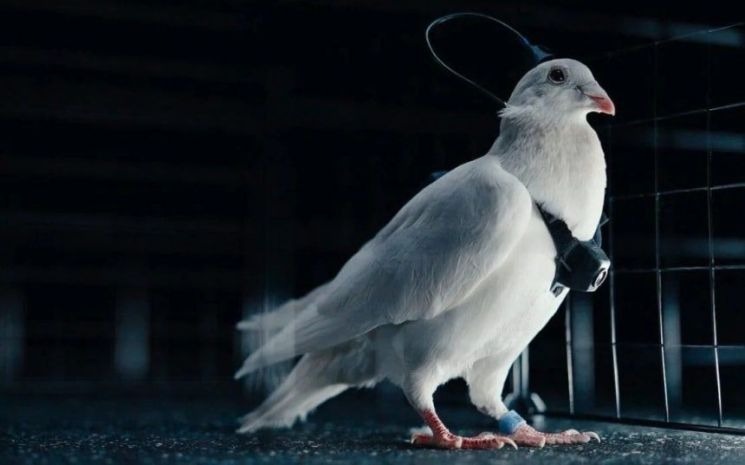
Recent reports have drawn curiosity and controversy over claims that Russian researchers are experimenting with co-called “pigeon drones”.
According to a report from the British Telegraph, the Nairi Group, a Moscow neurotechnology startup company, is developing a new drone using technology through birds. The project is called “PJN – 1”.
The technology contains miniature electrodes, which send signals to connected biological places. Specifically, the projects are planned to eject those electrodes into a pigeon’s brain. Then, those electrodes connect to a small unit of an attached body, allowing operators to send signals like changing directions during flight.
In reported prototypes, the pigeons will contain small backpack that include:
- A neural simulation device
- A flight-control unit
- Solar power components
- A small camera
Through this system, operators can track the bird’s position and control its movement.
Developers claim that they expect those “bio-drones” can travel longer distances than those conventional drones.
Even though using a bird for a military purpose seems unreal, it is actually based on a scientific background called “neural stimulation”. In animals like humans or birds, the brain sends electrical signals for other parts of the body’s movements. That said, if a tiny electrode is implanted in our brain that is related to direction, balance, and movement, the stimulation can influence the animal’s behavior.
Also, there are small reasons that pigeons are perfect for this project. Pigeons are usually able to return home even if it is hundreds of kilometers away. Moreover, pigeons have good endurance in flight. Moreover, pigeons are fittable in urban camouflage, as pigeons are animals that are easily seen in everyday life, which gives them an advantage in warfare zones. Lastly, as pigeons have been used in message delivery and military communication historically, the projects seem plausible.
However, even though the project has some plausible reasons, there are scientific challenges. In an animal’s brain, the brain is complex. Although birds’ brains are small, they are complex as those of humans. Therefore, there are possibilities that signals could not produce the same response. Animals may ignore the signals, and sending signals can cause fatigue. Furthermore, training pigeons can cost and experimenting for those electrodes can cost a lot of money. As drones are used for their cost-effective advantages, this can be a significant drawback. Most importantly, using animals in warfare and controlling animals’ behaviors artificially can cause ethical issues among the public.
In conclusion, pigeon drones, using brain-attached electrodes to send signals to those of bodies, can be an important military development, if it is made. Also, it can cause military benefits. However, the project has biological limitations, which must be overcome during development. Moreover, they must provide acceptable reasons for using animals as military equipment and prove that it is ethical.
By. Seunghu Chi
Works Cited
Kim, Hyunjeong. “‘Live Pigeons as Drones?’ Russian Development Raises Military Use Concerns.” 아시아경제, 5 Feb. 2026, cm.asiae.co.kr/en/article/2026020518073529022.
Seoul Economic Daily, and Yeo-jin Kim. “Russia Develops Brain-Chipped ‘cyborg Pigeons’ for Remote-Controlled Surveillance.” Seoul Economic Daily, 6 Feb. 2026, en.sedaily.com/international/2026/02/06/russia-develops-brain-chipped-cyborg-pigeons-for-remote.The Chosun Daily, and Ji-yeon Moon. “Russia Develops Brain-Implanted Pigeon Drones.” The Chosun Daily, 조선일보, 5 Feb. 2026, www.chosun.com/english/world-en/2026/02/05/SIOP54NTSZAKFEGZTCJLSIRBPU/.